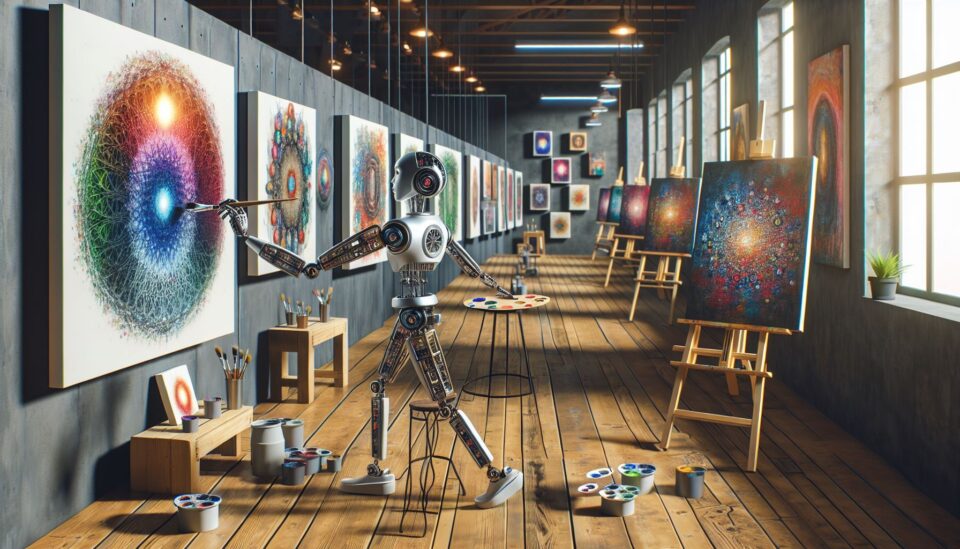
Hey there tech enthusiasts, pull up a chair and grab your favorite beverage, because today we’re going deep into one of the most exciting intersections of technology and creativity right now: artificial intelligence in the world of fine arts. As I sip my probably-too-strong coffee and stare at this blank screen, I find some comfort knowing that, contrary to what many creatives fear, AI isn’t about to steal our jobs… well, not quite yet, anyway.
The Recent Landscape: AI Breaks into the Art World
Remember 2018? Feels like ages ago, doesn’t it? That year, an AI-generated artwork by Obvious, a French art collective, sold at a Christie’s auction for a whopping $432,500. The artwork, titled “Portrait of Edmond de Belamy”, was created using a Generative Adversarial Network (GAN). It caused quite a stir in the art world, with some critics calling it the end of human creativity and others hailing it a major breakthrough.
The reality, as always, is far less dystopian than the doom-mongers might have you believe. The art itself was made using an algorithm trained on thousands of old portraits, but it was every bit as “curated” and “directed” by humans. Basically, humans gave the AI the brushes, and the AI painted within those boundaries.
The Brilliance of Generative Adversarial Networks (GANs)
Now, you’re probably wondering, “What the heck is a GAN, and how does it relate to my grandma’s watercolors?” Well, dear reader, I’m glad you asked.
GANs are a form of machine learning where two neural networks, one called the generator and the other the discriminator, compete against each other. The generator creates new samples from a given dataset, while the discriminator reviews these samples and decides whether they’re “authentic” (meaning part of the original dataset) or not.
So, in the case of our fancy AI artist, the generator would churn out a never-before-seen portrait, and the discriminator would play the role of our stuffy old art critic, determining if it fits the aesthetic of the original dataset.
The Human Factors: Artistry and Curation
I can hear the collective sighs of relief from the artist community everywhere. AI isn’t an existential threat just yet. Despite the fear-mongering clickbait headlines, AI in arts is nothing but a tool, albeit a very fancy and math-strong one, in the hands of an artist.
The humans behind the AI, those providing the dataset and writing the algorithms, have enormous influence on the final output. The AI doesn’t have a sense of aesthetic or composition, at least not in the human sense. It churns out what it’s trained to churn out, with the finesse and nuance provided by the human curator. So while an AI might be able to create something resembling the Mona Lisa, it sure as heck isn’t going to stifle your creative genius anytime soon.
Friday Night Speculations: The Future of AI in Arts
It’s that time of the blog post, folks. Let’s speculate about the future. As we move forward, AI will definitely become even more capable, more sophisticated, and yes, possibly more creative.
In my opinion, I see GANs and similar AI learning methods taking a side seat, coming in handy not as artists themselves, but as tools or aids for artists. Picture a world where an artist can outline their ideas for a piece and have an AI instantly help them realize it, co-create it. An augmentation of human creativity, if you will.
The artistic process can be one of deep introspection, of self-exploration, of translating one’s experiences, emotions, thoughts, into tangible forms. And while AI is brilliant (and slightly scary in its brilliance), it lacks the personal human experience essential to create art as we understand it.
So, Can Machines Really Paint?
So, can machines paint? Well, technically, yes. They can create visually striking, aesthetic representations of data they’ve been trained on, under the subtle and watchful guidance of a human artist. Can machines create art? That’s one philosophical rabbit hole that I’d rather not jump into today. Let’s save that for another day, ideally with a glass of wine or two.
What is clear though, is that AI has a place in the creative process. It’s new, it’s exciting, and love it or hate it, it’s here to stay. So, let’s embrace it, let’s explore its possibilities, let’s express through it. After all, isn’t that the very essence of art itself?
It’s your move, Picasso!