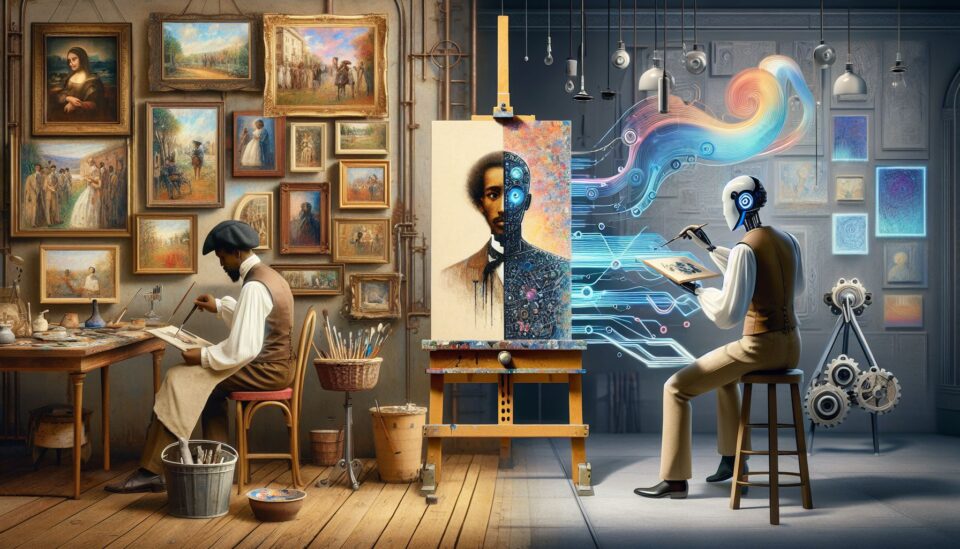
Wowza! What a ride it’s been for our good ol’ friend, Art. From prehistoric cave paintings to VR-based immersive installations, Art has been on quite a journey, hasn’t it? The newest addition to this odyssey is Artificial Intelligence, and boy oh boy, it’s already causing quite a stir!
Confession time: when I first heard about AI creating art, I was a skeptic. But, as a self-declared tech geek, I put on my curiosity cap and dove headfirst into this brave new world. And let me tell you folks, what I saw was nothing short of mind-blowing. So grab your popcorn (or your favorite nibbles) and read on, because it’s time for a wild ride into the world of AI in Creative Arts!
The AI Artist Invasion
Trust me, the ‘AI Artist Invasion’ isn’t the latest Hollywood Sci-Fi movie, though it sure sounds like one. It’s basically a fancy way of saying that AI is changing the way we create and appreciate art. Let’s take an example: remember “Portrait of Edmond de Belamy”? A piece of art created by GAN (Generative Adversarial Network) and sold for a whooping $432,500 at Christie’s! And the artist? An AI. If that doesn’t impress you, I don’t know what will.
Also, let’s not forget about AI in music. Take OpenAI’s MuseNet for instance. It can create four-minute-long musical compositions with ten different instruments and can even mimic classical composers like Mozart and contemporary pop stars like Adele. My mind was blown when I heard it for the first time. Hold up, I need a moment…Whew, okay let’s move on.
AI: The Ultimate Collaborator?
While some fear that AI might replace human artists (cue evil robot overlords), I see it more as a collaborator than a competitor. Look at it this way, haven’t artists always used tools to create their masterpieces? Paintbrushes, chisels, cameras, software…you get the drift. Now we just have a new tool in the toolbox: AI.
Stephen Thaler’s AI, called AARON, is a great example of this collaboration. AARON creates drawings, paintings, and even sculptures! However, it’s not fully autonomous. Thaler provides input and sets parameters, deciding the final output. It reminded me of a dog fetching a ball: the AI fetches art, and the artist decides if it’s ‘good boy’ or ‘bad boy’.
Creativity: Whose is it Anyway?
When AI produces art, who gets the credit? It’s a question as old as, well, 2015 when the first piece of AI art materialized. Does the AI, who conceives and executes the piece, get the claim? Or does the credit go to the human artist/programmer for creating and teaching the algorithm?
Philosophically, it brings us face to face with the question, “What is creativity?” Is it the ability to conceive something entirely new, rooted in the self (that’s AI out of the picture)? Or can it be the ability to generate a response that’s fresh, connecting the dots differently (welcome back, AI)?
When I think of creativity, it always involves an emotional aspect. Can AI feel emotion? Does it dream of electric sheep, like Philip K. Dick wondered? Only time will tell.
What Lurks Beyond?
The implications of AI in arts extend far beyond the canvas or the concert hall. It’s impacting industries like advertising, gaming, and movies, creating content which used to take human hours, sometimes even days, in a fraction of the time.
The advantages are enormous. Think of it: less manpower, cost efficiency, high productivity. Of course, it’s not a bed of roses. There are challenges, like ownership disputes, copyright issues, and looming ethical concerns.
Even with these challenges, the future of AI in Creative Arts seems bright, though a bit uncertain. We are at the precipice of an exciting new era that blends art and technology in unprecedented ways. Elon Musk rightly points out, “AI will make art more interesting”. However, he also cautions, “It may not be good for artists”.
As we stand at this crossroad, I can’t help but marvel at what AI has achieved. Who knows, the next Leonardo da Vinci might just be a string of code! Isn’t that an electrifying thought? So here’s to the future, a future where art is not just man-made, but algorithm-forged. So bring it on, AI, we’re ready for you!