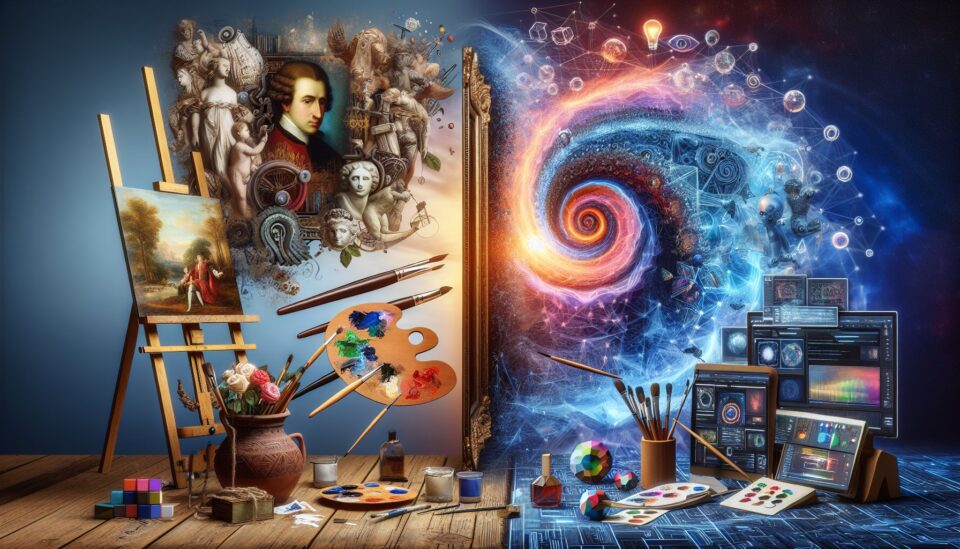
Good day, fellow tech enthusiasts! Today, I thought I’d set my sights on a unique blend of technology and old-school artistry — the intriguing mix of Artificial Intelligence (AI) and creative arts! Let’s get ready to explore how human creativity is crossing paths with the computational power of AI, sparking a digital renaissance right in front of our screens.
A Symbiosis of Art and Algorithm
Let’s face it, most of us, at some point, have been mesmerized by the graceful strokes of a Monet or the wild color experiments of Picasso; the emotional depth of art is universally celebrated. Yet here’s the twist: can this profound artistry be replicated, or even enhanced, by a machine?
Recently, we’ve seen jaw-dropping examples of AI jumping into the creative arena. You’ve probably heard of the portrait “Edmond De Belamy” created by a Parisian art collective called Obvious, right? It was made using a machine learning algorithm and, unlike my doodles in high school, this one was sold for a whopping $432,500 at Christie’s. That’s a mighty buck for an artist who doesn’t even have a physical body!
Even music, the rhythmical muse to our souls, hasn’t escaped the reach of AI. OpenAI’s “MuseNet” has been delivering impressive compositions, successfully imitating the styles of Mozart, The Beatles, and even metal legends like Metallica. That’s a range of musical talent my garage band could only dream of!
The Tech Behind the Canvas
Let’s dive a bit into the nerdy side (admit it, you love it!). So, how is AI managing to doodle past the boundaries of its silicon confines?
The secret sauce lies in a very special genre of machine learning algorithms known as Generative Adversarial Networks (GANs). In a nutshell, a GAN has two parts: a Generator that tries to create art, and a Discriminator that critiques the art. Over countless iterations, the two keep competing until the generator becomes an AI Picasso. Evidently, even machines learn from constructive criticism!
Scrapping the Idea of ‘Robotic’ Art
Now, I can almost hear traditionalists screaming into their Monet prints, “Can machine-made art ever be as rich and emotive as human-produced art?” Honestly, I believe there’s some legitimate concern there. As a lad, I recall my granny often saying, “Art comes from the heart!” But hold your horses, granny.
The question isn’t whether AI can replace human creativity, but rather, how it can amplify it. AI is blazing a new trail and “its handiwork is not something to fear or revere, but to critically engage with” says Anna Ridler, a London-based artist and researcher.
Google’s Magenta and DeepArt.io are superb examples. These platforms help artists explore new realms of creativity by integrating AI in their work, like creating an art style that combines Van Gogh and Warhol (combos my artsy friends wouldn’t stop talking about).
The Future of AI in Art: Fear or Frontier?
While we revel in the fascinating integration of AI and creative arts, this merger isn’t a one-way ticket to techno-utopia. It presents daunting challenges too. Intellectual property laws are going haywire trying to figure this out. If an AI creates a masterpiece, who’s the rightful owner — the programmer, the machine, or the user providing input? That’s a can of digital worms!
But these hurdles aside, the union of AI and artistry paints a promising future — more democratization of art, new exploratory tools for artists, and artwork capable of changing and adapting in real time to viewer interactions. We’re on the brink of a major shift; an era where AI expands the definition of art and challenges our understanding of creativity.
It’s humbling and thrilling to witness this new chapter unfold, a chapter where we are not just consumers of art, but engaged participants in a changing artistic narrative. The art world is indeed on the edge of a digital revolution, and for once, dear granny, the heart of this revolution beats through circuits and code.
So, as we stand at the start of this digital renaissance, let’s remember that it’s not just about admired canvases hanging in a fancy gallery. It’s about embodying innovation, breaking boundaries, and challenging old-school norms to explore unexplored realms of human creativity. And isn’t that what art, at its core, is all about?
Boy, oh boy, I am excited for what’s to come. Are you?