The Shift From Autocomplete to Autonomous Agent
There’s a meaningful difference between a code completion tool and an IDE that can actually execute decisions. I’ve spent enough time with sophisticated development environments to recognize when something fundamental shifts in how we work. Cursor’s Agent mode, introduced through the 0.4x release series, is one of those moments.
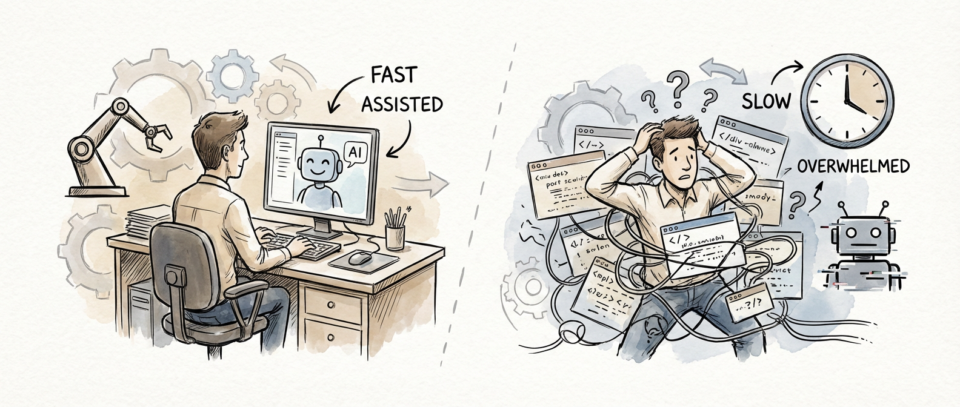
What we’re talking about here isn’t just faster autocomplete or smarter suggestions. Agent mode allows the IDE to autonomously execute multi-step coding tasks. It runs terminal commands, edits multiple files in sequence, and iterates on test failures without waiting for human prompting between steps. This is different. This is the IDE taking ownership of a task in a way that demands a recalibration of trust.
I set up a structured 30-day experiment to understand what this actually means in practice. Not a quick demo. Thirty days of real work, real projects, real stakes. The goal was simple: observe where Agent mode actually accelerates development and where it creates new categories of problems.
Watching the Numbers Climb and What They Tell Us
Before diving into my own observations, context matters. Cursor crossed 500,000 paying developer subscribers in late 2025. That’s not a vanity metric. That adoption rate, among an audience that includes notoriously tool-conservative senior engineers, signals something more than hype. These are people who’ve already made significant investments in their development workflows. They’re switching for a reason.
What’s particularly striking is the displacement pattern. A January 2026 survey by The Pragmatic Engineer newsletter found that 41% of senior engineers at FAANG-adjacent companies had adopted Cursor as their primary IDE. That’s the first time in years we’ve seen a meaningful shift away from VS Code in that cohort. These aren’t junior developers experimenting with new toys. These are architects and staff engineers making deliberate choices about their primary development environment.
Microsoft responded predictably. By late 2025, they’d accelerated Copilot Workspace features in VS Code Insiders builds, ultimately shipping a competing multi-file agent mode in February 2026. The arms race is real, and it’s moving fast.
The Speed Gains Are Real, But Read the Fine Print
Let’s start with what’s objectively true: the MIT Computer Science and AI Lab published research in 2025 showing developers using agentic AI coding environments completed unfamiliar codebase tasks 55% faster than control groups. I’ve seen that speedup firsthand. There’s a category of work, particularly initial implementation in unfamiliar domains, where Agent mode genuinely changes the game.
I spent a week building integrations with three different payment processors. Normally, this is pattern-matching work: read documentation, understand API structure, implement handlers, write tests. With Agent mode handling the scaffolding and iteration, I cut the time in half. The IDE would read documentation, generate handler stubs, run the test suite, see failures, adjust the implementation, and continue until tests passed. I reviewed the final output. This worked.
But here’s where the analysis gets complicated. That same MIT research noted something critical: developers using agentic systems introduced 22% more security-relevant code patterns requiring review. That’s not a minor footnote. That’s a structural trade-off built into the speed equation.
Over my 30 days, I caught real issues the agent had generated. API key handling that wasn’t optimal. Database query patterns that would fall apart at scale. Nothing catastrophic, but the kind of thing that would have taken longer to find in production. The agent was moving fast, but fast doesn’t mean careful.
Where Agent Mode Breaks Down and Why It Matters
The honest assessment requires identifying where this approach falters. Agent mode works best in domains where success criteria are unambiguous. Test suites pass or they don’t. Code compiles or it doesn’t. But software engineering is full of ambiguous territory.
I spent days working with an agent on architectural decisions where the “correct” answer involved trade-offs between performance, maintainability, and team familiarity. The agent would generate solutions optimized for a narrow criterion, say minimum latency, without understanding the broader context. It needed constant human course correction. This isn’t a failure of the technology. It’s a reflection of the fundamental nature of the problem.
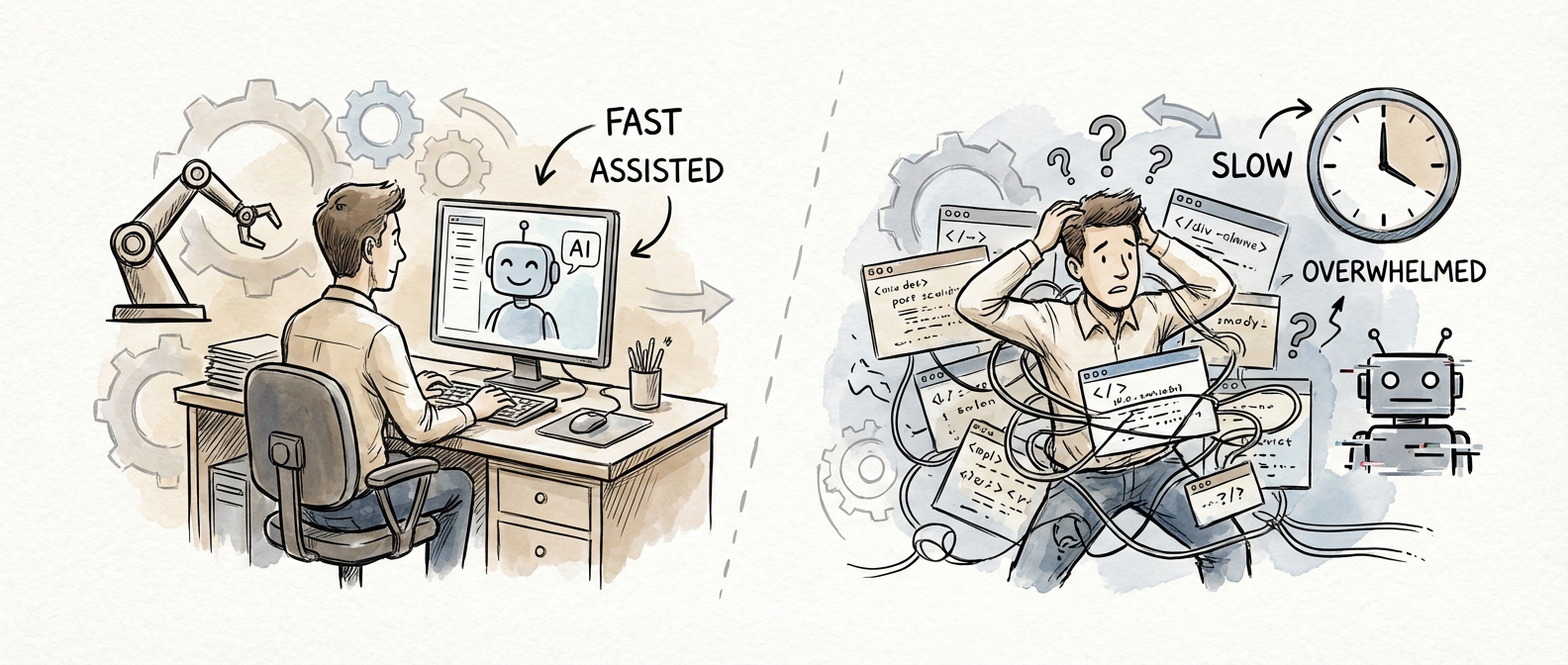
There’s also the question of context depth. Agents work with what they can see and what you explicitly tell them. I found myself spending more time setting up the agent with context, explaining previous decisions, architectural constraints, team conventions, than I would have spent simply solving the problem myself. For work that lives in deep context, Agent mode can actually add friction.
Signal Versus Speculation: What Comes Next
Based on 30 days of actual work with this technology, I can separate what I’ve observed from what I’m forecasting. The observed part: agentic IDEs accelerate specific categories of work. They reduce friction in scaffolding and testing. They’re becoming standard in senior engineering workflows. That’s signal.
The speculation part: I don’t yet know how this scales to collaborative environments where multiple engineers work on the same codebase. I don’t know whether the security review burden becomes prohibitive as adoption deepens. I don’t know whether these tools improve code quality long-term or just move problems downstream. These are genuinely open questions, and anyone telling you otherwise is guessing.
What I do know is that we’re at an inflection point. The distinction between “tools that suggest code” and “tools that execute code” is more than incremental. It changes incentives, workflows, and demands a rethink of code review practices and testing discipline. The Cursor changelog and Agent mode docs show rapid iteration on these capabilities, which suggests the companies building this infrastructure are taking the technical challenges seriously.
If you’re a developer who hasn’t spent meaningful time with agentic systems yet, the research and adoption data both suggest you should. Not because it’s trendy, but because understanding your tools during a period of this much change is part of staying relevant in this work. If you’ve already started experimenting, I’d be curious what patterns you’re seeing that differ from my experience. The most useful insights at this stage come from engineers actually doing the work.