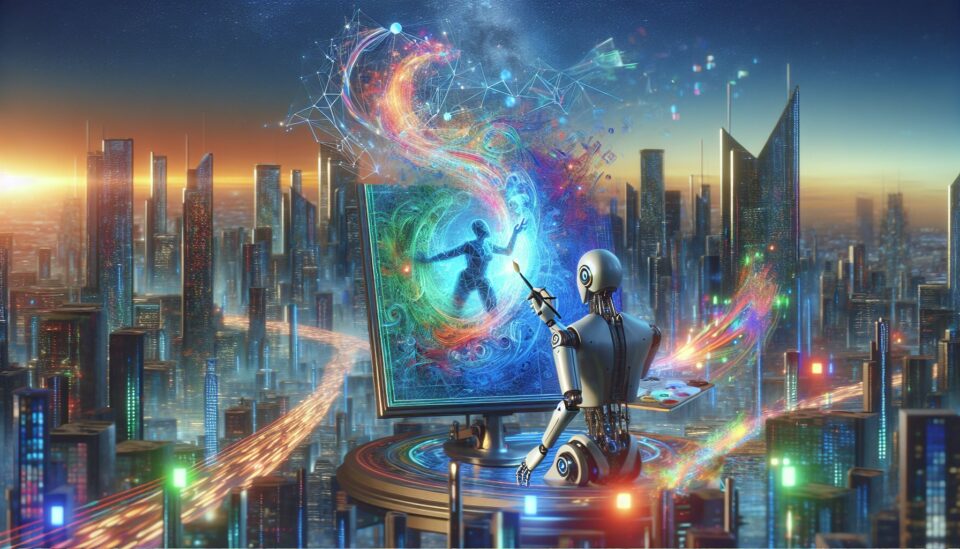
Long gone are the days when art was solely a manual, human-driven endeavor. Today’s art scene is being redefined and reshaped by none other than technology’s latest brainchild: Artificial Intelligence (AI). Machine learning has infiltrated into the realm of artistic expression, revolutionizing the process of creation. It’s like Picasso once said, “Computers are useless, they can only give you answers”….but sorry Pablo, they’re now giving us much more, sonnets, symphonies and even surrealistic paintings!
A Delightful Encounter with AI Art
You know it’s a remarkable time to be alive when you can casually type words into a website at two in the morning, and a minute later, have an AI transform your thoughts into a beautiful portrait, or even an entire graphic novel. With the pandemic keeping most of us indoors, I’ve had some fascinating late night rendezvous with AI art tools such as DeepArt and Art.ai. These tools use AI algorithms to generate pieces that sometimes, I swear, make you question if the AI has somehow found its way into my deepest memories.
How GANs Make AI Art Work
AI art is made possible through a type of machine learning called Generative Adversarial Networks (GANs). Remember that exhilarating moment when your parents removed the training wheels from your bike and you finally learned to balance? That’s what GANs do: helping computers balance two conflicting objectives to create something new.
A GAN has two neural networks, the “generator” and the “discriminator.” The generator creates new data instances, while the discriminator evaluates their authenticity. In a ceaseless powerplay, the generator improves its productions, while the discriminator becomes increasingly astute in identifying the generated instances. It’s sort of like an artistic cat-and-mouse game, except the cat and mouse help each other’s development.
Breaking New Ground: OpenAI’s DALL-E
Tech communities and art enthusiasts alike were abuzz early this year when OpenAI, the folks behind GPT-3, revealed DALL-E. This AI program can generate images from textual descriptions, no matter how absurd, like an “armchair in the shape of an avocado.” Running on a custom GAN, DALL-E has the potential to revolutionize graphic design, advertising, and animation industries. However, are we ready to grapple with the ethical and economic implications of AI in industries traditionally reliant on human creativity? Only time will tell.
Unexplored Territory: AI and Intellectual Property Rights
A fascinating question that arises in the wake of AI-generated art is the matter of ‘ownership.’ If AI software generates a masterpiece, who gets the credit? The software’s creator? The AI itself? This presents a novel facet to the age-old intellectual property debate.
A high-profile example occurred when an AI-generated painting called “Portrait of Edmond Belamy” was sold for an astonishing $432,500 at Christie’s auction house. Some scratching of heads (and I imagine, some pulling of hair) ensued among the art world. The incident forced us to reckon with this new reality and consider how copyright laws must adapt in our perpetual dance with technological advancement.
The Future: A Blend of Human and AI Creativity
So, what does the future hold? Are we heading towards a dystopian world of robotic-loving art connoisseurs and starving human artists? Personally, I’m an optimist. I believe in a future where AI and human creativity coexist, encouraging innovation in ways we can’t even fathom. After all, AI can’t replace the emotional depth, individual experiences, and complex outlooks that underpin human artwork.
Rather than viewing AI as a threat, we should embrace it as an opportunity to push the boundaries of our imagination. As for my late-night art endeavors, last night, I asked an AI to create “a fusion of Van Gogh’s Starry Night and my cat, Muffins.” The result? A masterpiece, or so I think.
In closing, let’s remember something important. AI art opens up an untapped universe of creative possibilities, but it doesn’t negate the magic of a raw, human-crafted creation. It’s not about replacing the brush, but rather about itching to see what other tools we can bring to the canvas!
Cheers to an exciting era of AI-powered creativity!